
Explore the differences between drying methods to convert liquid products into powders to determine the best option for each unique product.
Comparisons of Dynamic Atomization to Spray and Freeze Drying
The following table illustrates the advantages of dynamic atomization by considering important features of the technique and the resulting powder against the two primary alternative methods:
| Dynamic Atomization | Spray Drying | Freeze Drying | |
| Low Time Scale | ✓ | ✓ | ✖ |
| Low Moisture | ✓ | ✓ | ✓ |
| Less Time Exposed to High Heat | ✓ | ✖ | ✓ |
| Suitable for Viscous Materials | ✓ | ✖ | ✖ |
| Solubility | ✓ | ✓ | ✓ |
| Controlled Particle Sizes | ✓ | ✓ | ✖ |
| Large Volume Capabilities | ✓ | ✓ | ✖ |
| Low Cost | ✓ | ✖ | ✖ |
| Low Pressure | ✓ | ✖ | ✖ |
| Biological Activity Maintained | ✓ | ✖ | ✓ |
| Protein Structure Maintained | ✓ | ✖ | ✓ |
Drying Processes
Dynamic Atomization: New Technology
Dynamic Atomization provides a new alternative to spray drying that uses improved turbulent atomization technology to separate liquid droplets at low to zero pressure and maintains air flow in the drying chamber to reduce heat exposure. This makes it more suitable for fragile and biologically active ingredients and molecules.
APD Dynamic Atomization
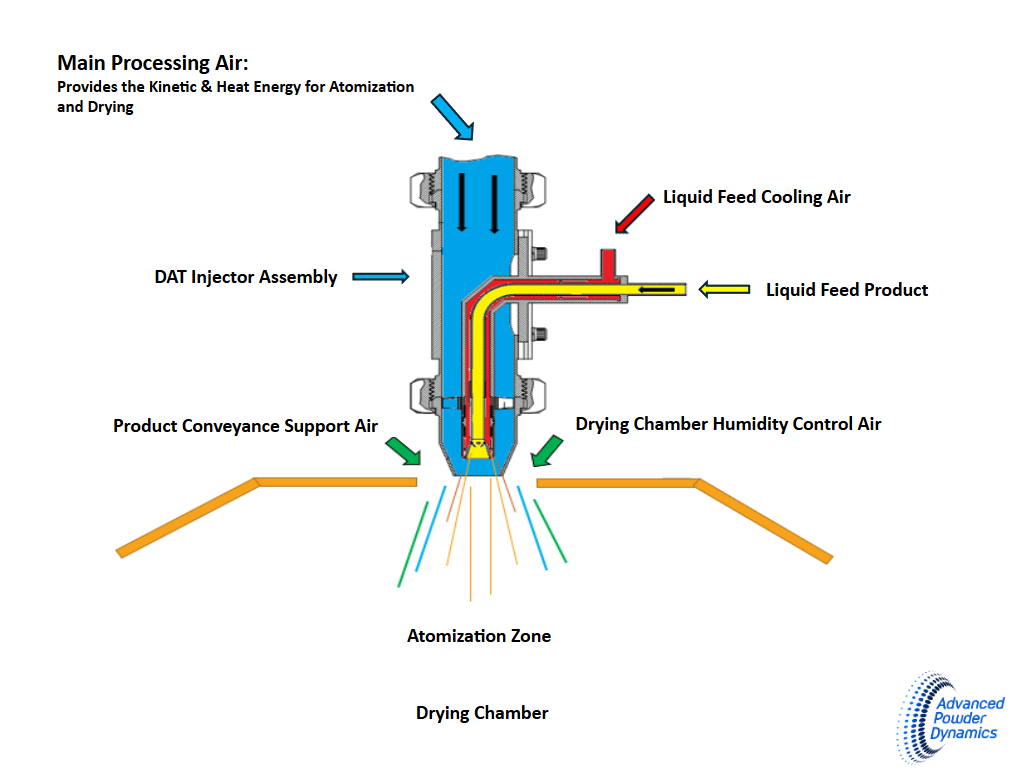
- Liquid material is pumped to the top of a drying chamber
- Specialized nozzles create an optimum spray pattern at low pressures ( < 5psi) to preserve biological agents and avoid clogging nozzles with viscous material
- Atomized particles are exposed to high turbulence and high heat transfer via controlled Process Air
- Conveyance Support and Humidity Control: controls humidity inside the drying chamber and supports conveyance of the product out of the drying chamber
| Advantages of Dynamic Atomization Technology |
| ✔ Precision control over moisture content and powder specifications ✔ Zero pressure eliminates mechanical sheer, abrasion, and degradation of product ✔ Enhance conveyance of the powder out of the drying chamber and through the system ✔ Minimized intra-molecular water activity ✔ Fast drying: typically ~0.5sec |
Learn more about our dynamic atomization services.
Cost Advantages of Dynamic Atomization
Dynamic Atomization reduces maintenance costs by up to 90%, which lowers the competitive pricing of this method. This comes as a result of the following measures:
- Lower utility costs – freeze-dry quality powders at a lower cost
- Better handling of higher viscosities – less clogging of nozzles
- Lower pressure system – no need for specialized vacuum
- Advanced control over chamber temperature and humidity – no “hot spots”
Spray Drying: Traditional Standard
Spray drying is the process of converting a liquid product into individualized tiny droplets using a spray nozzle at high velocity. These droplets are then exposed to a chamber at high heat to remove any moisture and convert the product into a fine powder.
- Pumpable liquid is sprayed through one or more nozzles
- Atomization of the liquid is conducted to create optimal conditions for fast drying
- First stage of drying: evaporation takes place at a relatively constant rate as the moisture inside the sprayed droplet replaces that which is evaporated from the surface
- 95% of the water is removed quickly
- Second stage of drying: dried shell forms on the surface when there is not enough moisture left to sustain constant evaporation, and the rate of evaporation slows to the rate at which the moisture can pass through the outer shell
- Different products have different reactions to this stage of evaporation, some maintaining a relatively uniform and stable shape while others contract, fracture, or disintegrate
- Separation of particles is conducted as gravity forces most of the powder to the bottom of the chamber, and some remaining particles must be removed via a filtration system
| Advantages | Disadvantages |
| ✔ Fast drying: 20-30 seconds ✔ Uniform particle size ✔ High, efficient yields | ✘ High energy consumption ✘ Degradation of biologics: Suitable only for materials stable in high heat |
Freeze Drying: More Stable Alternative
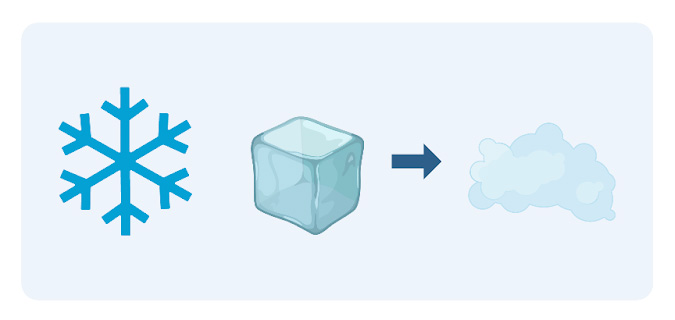
Freeze drying is a slightly less damaging alternative to spray drying. Instead of exposing individual droplets to high heat for drying, they are flash-frozen first and then exposed to a vacuum source, where water is removed through sublimation – the process of converting solid ice to liquid vapor.
- Liquid material is frozen below its triple point to ensure that heating will result in sublimation to a gas rather than melting back to a liquid
- Methods of freezing: freezer, chilled bath, shelf in freezer of chamber
- Freezing must be done rapidly to avoid the formation of ice crystals that could damage the biological material
- First stage of drying (sublimation): pressure is lowered in a vacuum chamber and heat is added to slowly convert frozen water to vapor
- 95% of the water is removed slowly
- Second stage of drying (adsorption): porous structure of freeze-dried materials allows trapped water molecules to escape when the temperature is raised to break the bonds
- Can remove up to 1-5% additional water
| Advantages | Disadvantages |
| ✔ Less damage from heat and spray nozzles ✔ Lower temperatures protect biological activity and serve a wider range of active products | ✘ Longer drying time: minutes ✘ Lower production efficiency: less volume of material dried ✘ Different equipment chambers required: expensive |
BioRender
Product Outcomes From Different Drying Processes
As the different drying techniques for developing powders – spray, freeze, and dynamic atomization – involve different processes, they also result in different outcomes in the product materials. Evidence of a good powder drying method is to be versatile, fast, and cost-effective, but also retain the same properties as the original liquid product. The different drying techniques are compared by the resulting features of the powders they produce:
Spray Dried Powders:
- Evenly sized particles
- Degradation and loss of bioactivity
- Large quantities in a short time scale
- Prolonged stability and longer shelf life
Freeze Dried Powders:
- Evenly sized particles
- Maintenance of bioactivity
- Nutrient protection by maintaining original structure and function
- Smaller quantities in a longer time scale
- Prolonged stability and longer shelf life
Dynamic Atomization Powders:
- Evenly sized particles
- Maintenance of bioactivity
- Additional protection for bioactive molecules
- Large quantities or small quantities available in short time scale
- Prolonged stability and longer shelf life
Advanced Powder Dynamics offers dynamic atomization at scale to provide the highest quality powders at low cost and low wait times.
The Future is Dynamic Atomization
The development of powdered products is improved when considering biostability, scalability, and overall cost. Dynamic atomization offers a method that maintains biological activity while reducing the duration of heat exposure, time, and cost, and is capable of large-scale production. It combines the speed and efficiency of traditional spray drying techniques with more delicate handling measures to mimic the capabilities of freeze drying. This makes it a low-cost, versatile choice for many powdered products.
Learn more about our dynamic atomization services.

Will West, a Harvard MBA, has a proven track record of scaling businesses, having expanded HID Global Corporation’s revenue from $200 million to $1 billion through strategic acquisitions. As Co-founder, CFO, and COO at ACRE, LLC, he transformed the company into a $350 million global leader. His vision now drives Tesseract Life Sciences’ mission to redefine health with science-backed innovations.